
Physical AI for commercial beekeeping.
PollenPal is hardware and ML that watches every bee in and out of the hive, catches threats the day they appear, and sells through a $5 to $20 per hive per month subscription with hardware bundled.
U.S. beekeepers lose 40 percent or more of their colonies every year¹ and the 2024-25 season was the worst on record, with commercial operators losing 62 percent of colonies and an estimated $600M in revenue.² The workforce is aging, the inspection cadence is slow, and the threats are accelerating. Continuous monitoring is the only way out, and falling sensor and compute costs make it economic for the first time.
We have spent the last year proving that physical AI can carry the inspection load. Three commercial operations have committed to 6-month pilot programs with conversion to paid, and 4 devices are live in the field today. Our models have logged 3.5M+ individual bee observations across 450,000 hive images. The web app is live in production, with self-serve signup, a 30-day free trial, and Stripe billing since June 2026. Robert spent the summer of 2025 driving across the country, interviewing 50+ beekeepers, and the conclusions are now in our product. The team pairs a 17-year hobbyist beekeeper (Robert, Columbia MBA) with an Apex Space hardware engineer (Daniel, ex-Blue Origin) who have worked together for nine years.
We are raising a $500K pre-seed SAFE to fund production hardware, on-prem GPU inference, and the first paid commercial deployments. $62K+ of non-dilutive funding is already secured.
- ¹ Bee Informed Partnership, Annual Colony Loss Survey. beeinformed.org/results-categories/honey-bee-colony-losses ↩
- ² Honey Bee Health Coalition, 2024-25 catastrophic loss data. honeybeehealthcoalition.org; Auburn University U.S. Beekeeping Survey 2024-25. ↩
Bees feed the world. The workforce can't scale to keep up.
U.S. beekeepers lose 40 percent or more of their colonies each year while food demand rises, and the aging workforce cannot inspect every hive often enough to catch threats before they spread.
Pollinators carry roughly 35 percent of global food production by volume.¹ The FAO projects 60 percent more agricultural production needed by 2050.² The math doesn't work without healthy hives, and hive health is collapsing.
The 2024-25 season set a record: commercial operators lost 62 percent of colonies and roughly $600M in U.S. revenue.³ Varroa mites, africanization, and queen failure are the proximate causes, but the structural issue is inspection cadence. The average commercial beekeeper is over 60.⁴ Yards run thousands of hives. Manual inspection visits a colony every two to three weeks. By the time a problem is caught, the cluster is already collapsing.
"How the f**k can you get through 10,000 hives with 10 employees?"Kristen, Master Beekeeper · 20 years' experience · interviewed July 2025
Robert spent the summer of 2025 driving across the country, interviewing more than 50 commercial and hobbyist beekeepers in CA, TX, FL, CO, and NY.⁵ Every commercial operator surfaced the same gap: they need eyes on every hive, every day, and there is no labor pool to do it. The old way is human inspection on a multi-week cycle. The new way has to be physical AI, and falling sensor and compute costs are the reason it works now.
- ¹ FAO; Klein et al. 2007, Importance of pollinators in changing landscapes for world crops. Proceedings of the Royal Society B. royalsocietypublishing.org ↩
- ² UN FAO, World Agriculture Towards 2030/2050. fao.org/3/i6583e/i6583e.pdf ↩
- ³ Honey Bee Health Coalition, 2024-25 catastrophic loss data; Auburn University U.S. Beekeeping Survey 2024-25. honeybeehealthcoalition.org ↩
- ⁴ Apiary Inspectors of America 2024-25 Survey. apiaryinspectors.org/US-beekeeping-survey-24-25 ↩
- ⁵ Customer interviews, summer 2025. n=50+ commercial and hobbyist beekeepers across CA, TX, FL, CO, NY. ↩
Computer vision on every hive entrance.
We put computer vision on every hive entrance and surface threats the day they appear, instead of weeks later during manual inspection.
Three integrated layers (hardware, machine learning, and a beekeeper-facing web app) replace the fortnightly inspection visit with continuous monitoring.
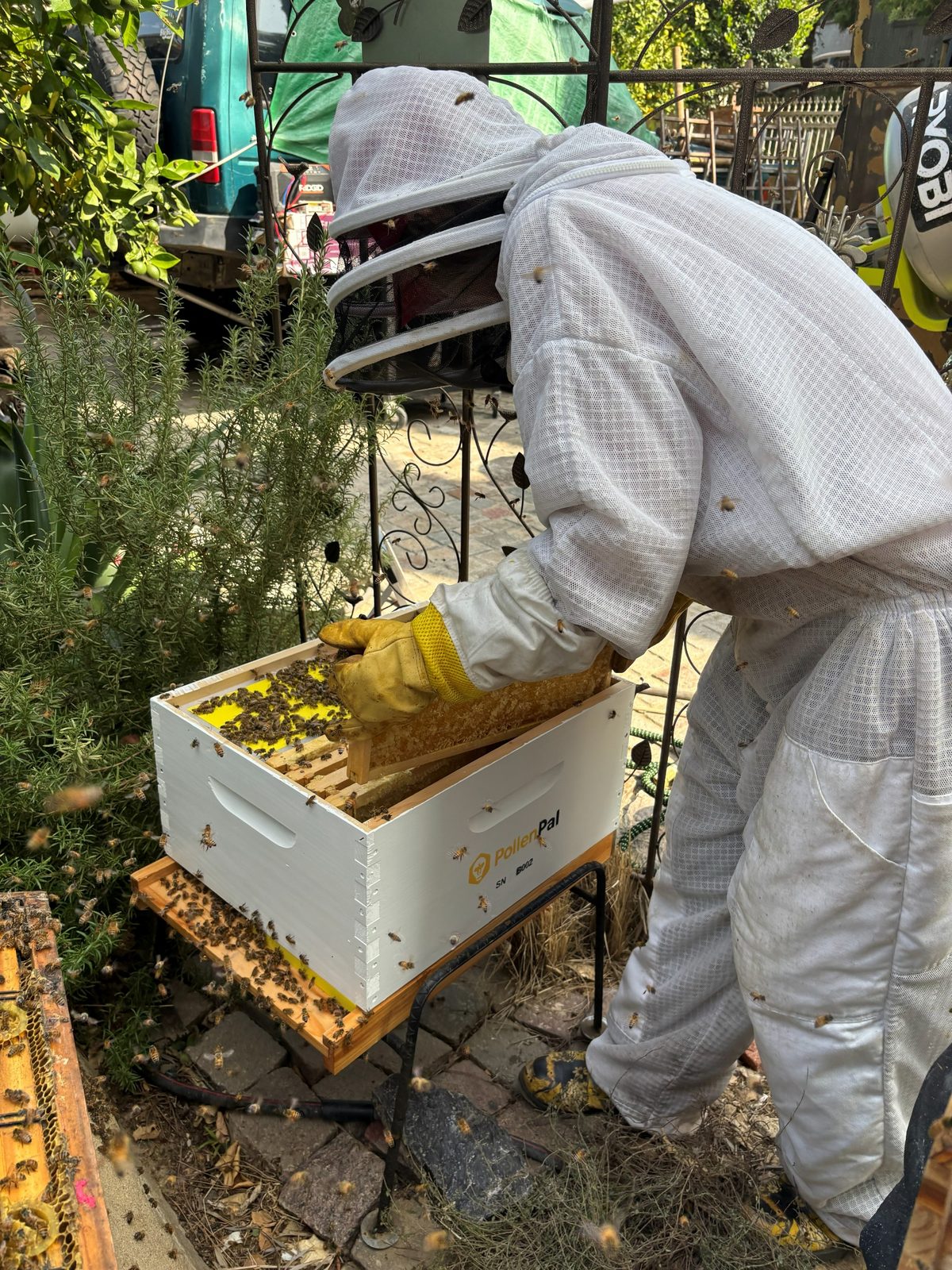
Hardware
Off-the-shelf IoT compute and sensors, with hardware cost falling from $190 to $55 per hive as volume scales.¹ A 3D-printed skeleton fits standard 10-frame Langstroth boxes (no custom hive bodies) and integrates sound sensors plus external switches for labor coordination. Solar plus LTE for remote yards. 25 design variations have gone through commercial-yard testing across California and Florida apiaries.
Machine Learning
Our models have logged 3.5M+ individual bee observations across 450,000 hive images, annotated through our CVAT pipeline.² The model tracks colony activity in real time and flags varroa mites, africanization markers, and missing-queen indicators. Cloud inference today; on-prem GPU on the roadmap (funded by §12 Ask) for 80 percent inference cost cut and sub-second latency.
Web App
Live in production today: real-time monitoring, hive-level alerts, multi-yard rollups, and digital inspection logs that pair ground truth with camera data. Self-serve signup with a 30-day free trial and Stripe billing has been live since June 2026, and an investor demo account is available. Designed with beekeeper input: actionable insights over complex graphs. The data flywheel from this product is what compounds (see §6 Competition).
- ¹ PollenPal financial model (June 2026). Hardware cost per hive falls from $190 (2027) to $55 (2030) at contract-manufacturer volume. ↩
- ² Internal training pipeline; 450,000+ hive images captured with independent beekeepers across California and Florida (9 apiaries, multiple seasons since August 2025), annotated via a self-hosted CVAT instance. ↩
Subscription with hardware bundled, three channels.
Pricing is $5 to $20 per hive per month across three channels, gross margin scales from 22 percent (2027) to 59 percent (2030) as hardware cost falls $190 to $55, and hardware bundling removes the upfront capex barrier that interview after interview surfaced as the #1 friction.¹
| Commercial | Hobbyist | Partnership | |
|---|---|---|---|
| Subscription | $5/hive/mo → $10 by Yr 5 | $8/hive/mo → $12 by Yr 5 | $20/hive/mo (25% rev share) |
| Setup | $2,500 one-time | none | bundled |
| Hives / customer | ~2,000 | 5 | 50 to 8,000 managed |
| ACV | $120K at full deployment | $480 (Yr 1) | varies |
| Channel | Direct sales | Self-serve | Best Bees, Alvéole |
| Hardware | Bundled | Paid up front | Bundled |
U.S. hive management at scale across all three channels is roughly $250M ($228M commercial + $19M hobbyist + $4M partnership).² The deeper market geometry sits in §5 Market Opportunity.
The four fits
The model is engineered around the four fits framework: each adjacent pair has to be coherent, or the system breaks.
Product / Market. Hardware plus continuous CV solves the inspection-cadence gap that every commercial interview surfaced. Continuous monitoring replaces 2-3 week manual inspection.
Market / Channel. Commercial: direct sales to ~1,600 concentrated U.S. operators (a known list, named accounts). Hobbyist: self-serve via paid social and content. Partnership: B2B2C through corporate beekeeping platforms (Best Bees, Alvéole), which collectively manage hives across 24+ U.S. cities.
Channel / Model. Direct sales fits the $120K full-deployment commercial ACV; self-serve fits the $480 hobbyist ACV; partnership rev-share (25 percent) fits B2B2C platform economics.
Model / Market. Subscription compounds ARR and amortizes hardware over multi-year contracts; bundling removes the capex barrier in a market where digital adoption is structurally low.
- ¹ Customer interviews, summer 2025; PollenPal financial model (June 2026; gross margin trajectory derived from hardware cost scale curve). ↩
- ² PollenPal financial model (June 2026). U.S. hive management = $228M commercial + $19M hobbyist + $4M partnership. Commercial operator base from USDA NASS Honey Report 2024. ↩
$106B TAM, $24B SAM, $250M SOM.
PollenPal starts inside U.S. hive management ($250M SOM across commercial, hobbyist, and partnership channels) and the SAM expands into crop monitoring and treatment ($24B), with precision crop protection ($106B) as the long-term ceiling.
SOM. $250M U.S. hive management
$228M commercial + $19M hobbyist + $4M partnership, bottom-up from ~1,600 commercial operators at ~2,000 hives each.¹ This is the playing field for 2026-2028: a known operator list, named accounts, direct sales motion. We have line of sight to roughly $24M revenue by 2030 (§8 Financial Overview).
SAM. $24B crop monitoring and treatment
The precision farming market is projected to reach $24B globally by 2030.² PollenPal's SAM is pest detection across orchards, vineyards, and greenhouses, plus the treatment sales it directs. Our hive sensors and ML pipeline transfer naturally. Bees are mobile sensors that already surface yield-relevant data we can monetize beyond the hive itself.
TAM. $106B precision crop protection
The global crop protection market is projected to reach $106B by 2030.³ The long-term play: IoT monitoring, an intervention marketplace, pollination verification, and a precision application OS. We're not building a chemical company; the long-run ceiling for precision monitoring is the size of what it ultimately optimizes against.
Precision Crop Protection
IoT, intervention marketplace, pollination verification, precision application OS.
Crop Monitoring + Treatment
Pest detection across orchards, vineyards, and greenhouses, plus treatment sales.
U.S. Hive Management
PollenPal hardware and software subscriptions sold to U.S. beekeepers.
- ¹ PollenPal financial model (June 2026). SOM = $228M commercial + $19M hobbyist + $4M partnership. Operator count and aggregate hive count from USDA NASS Honey Report 2024. nass.usda.gov ↩
- ² Grand View Research, Precision Farming Market Size, Share | Industry Report, 2030. grandviewresearch.com ↩
- ³ MarketsandMarkets, Crop Protection Chemicals Market 2025-2030: $83.32B (2025) → $106.26B (2030), 5.0% CAGR. marketsandmarkets.com ↩
The first to be both accurate and deployable.
Existing tools force a tradeoff between actionable accuracy and affordable deployment; PollenPal is the first to be both, and the data flywheel compounds with every bee we see.
Today, beekeepers solve the inspection-cadence problem in one of four ways:
Manual inspection. Accurate when it happens, but operators visit each hive every two to three weeks. By the time a problem is caught, the cluster is already collapsing. Labor cost is the binding constraint, not technology.
BroodMinder ($50 to $200/yr per device).¹ Weight and temperature sensors only. No behavioral signal. Detects late-stage colony failure but cannot flag varroa load, africanization markers, or queen issues until the bees are already gone.
Solution Bee. Acoustic monitoring. Real signal but limited interpretability; operators we interviewed described the alerts as noise.
Beewise (~thousands per colony). Full automation but proprietary hive bodies. Doesn't fit standard 10-frame Langstroth setups, so existing operators would have to rebuild their yard infrastructure to adopt.
Unfair advantages
Data flywheel. Every bee we image and every inspection log we collect improves the model. Competitors don't have visual datasets at this scale; the gap widens with every yard we deploy. This is the moat that compounds: software, not hardware (see §3 Solution).
Founder-operator fit. Robert is a 17-year beekeeper, not a generalist founder pivoting into ag. Daniel built spacecraft hardware at Blue Origin and Apex Space. The product reflects what beekeepers actually need, drawn from fifty interviews and Robert's own hives.
- ¹ Competitor positioning sourced from public marketing materials and customer interviews. BroodMinder pricing: broodminder.com. Beewise architecture: beewise.ag. ↩
Search → Systematize → Scale.
Three phases: Search (now: threat detection in commercial pilots), Systematize (next: insightful recommendations and corporate beekeeping channel), Scale (later: autonomous response and crop expansion).
Each phase has a product milestone, a GTM motion calibrated to that product's unit economics, and a single inflection point that, once cleared, unlocks the next phase.
| Now (Search) · 2026 | Next (Systematize) · 2027 | Later (Scale) · 2028+ | |
|---|---|---|---|
| Product | Threat detection (varroa, africanization, queen) | Insightful recommendations (treatment timing, crew dispatch) | Autonomous response; crop / orchard expansion |
| GTM motion | Direct sales: convert 3 committed pilots → paid deployments | Corporate beekeeping platform partnerships (Best Bees, Alvéole) | Enterprise + international; crop monitoring expansion |
| Unit econ | $5/hive/mo, $120K ACV at full deployment | + $20/hive/mo partnership tier (25% rev share) | ARPU $10, GM 59% |
| KPI | 221-device pilot fleet deployed | $587K revenue (2027E) | $24M revenue (2030E) |
| Inflection | First paid commercial deployment | First $1M ARR | Profitability (EBIT positive) |
Search (2026). Confirm three things: hardware survives 12 months in a commercial yard, the model holds accuracy across geographies, and beekeepers will pay $5/hive/mo for what the dashboard surfaces. Three commercial operations have committed to 6-month pilot programs with conversion to paid, and 4 devices are live in the field today.¹ Use of funds is structured around this phase (§12 Ask).
Systematize (2027). Layer recommendations on top of detection (treatment timing, crew dispatch, yard trends) and open the corporate beekeeping channel with Best Bees and Alvéole. The partnership channel unlocks our first $1M ARR without a large direct-sales team.
Scale (2028+). Autonomous response (closing the loop with in-hive interventions) and SAM expansion into crop monitoring (§5 Market). Path to $24M revenue and EBIT-positive operations by 2030 (§8 Financials).
- ¹ PollenPal financial model (June 2026). ↩
$57K to $24.2M revenue, 2026 to 2030.
Revenue scales from $57K (2026) to $24.2M (2030); EBIT turns positive in 2030 at a 14 percent margin, supported by hardware cost falling $190 to $55 and ARPU rising as the feature stack matures.¹
| 2026 | 2027 | 2028 | 2029 | 2030 | |
|---|---|---|---|---|---|
| Revenue | $57K | $587K | $3,311K | $10,324K | $24,197K |
| Gross profit | ($6K) | $131K | $1,162K | $4,967K | $14,207K |
| Gross margin % | (11%) | 22% | 35% | 48% | 59% |
| Operating expenses | ($463K) | ($1,668K) | ($3,187K) | ($5,925K) | ($10,850K) |
| EBIT | ($469K) | ($1,537K) | ($2,025K) | ($958K) | $3,357K |
| EBIT margin % | n.m. | (262%) | (61%) | (9%) | 14% |
Key assumptions, named
Fleet. 221-device pilot fleet in 2026, scaling via contract manufacturer from 2027. Commercial farms at ~2,000 hives each.
Pricing. ARPU $5 → $10 per hive per month commercial; $8 → $12 hobbyist; $20 partnership (25 percent rev share). $2,500 one-time setup commercial.
Churn. 0.7 percent monthly across both segments. This is best-in-class for B2B SaaS² and is optimistic for hobbyist; pilot data will calibrate.
HW cost. $190 per hive in 2027 falling to $55 by 2030, driven by contract-manufacturer volume curves.
CAC. Commercial CAC paid back in ~5 months at scale, supported by $120K full-deployment ACV; partnership rev-share bypasses CAC.
- ¹ PollenPal financial model (June 2026). All figures derived from named assumptions in the Assumptions tab. ↩
- ² Churnfree, B2B SaaS Benchmarks 2026. Best-in-class B2B SaaS monthly churn is below 1 percent; SMB-focused products typically run 3-7 percent monthly. churnfree.com ↩
From data collection to revenue.
Platform live in production. 4 devices in the field. 3.5M+ bee observations across 450,000 hive images. 3 committed pilot operations. 50+ beekeeper interviews. $62K+ non-dilutive secured. Moving from data collection to revenue in 2026.
To date
Customer discovery. 50+ beekeeper interviews (summer 2025 cross-country road trip + phone calls). Sample selection: commercial operators with 500+ hives across CA, TX, FL, CO, NY. 4 Master Beekeepers retained as ongoing advisors.¹
Hardware and data. 25 design variations tested. Devices deployed with independent beekeepers across California and Florida (9 apiaries, multiple seasons since August 2025). 450,000+ hive images captured, 3.5M+ individual bee observations, 60+ hand-logged inspections paired to camera data.
Platform. Web app live in production: real-time monitoring, alerts, and digital inspection logs. Self-serve signup with a 30-day free trial and Stripe billing, live since June 2026. Investor demo account available.
Commercial. 3 commercial operations committed to 6-month pilot programs with conversion to paid; 4 devices live in the field today. 25+ hobbyists on waitlist. $62K+ non-dilutive funding secured (Columbia University + others).
Next 12 months
H2 2026. Production-ready hardware (221-device pilot fleet, IP67 enclosure, FCC certification, contract-manufacturer tooling). Funded directly by the $240K hardware bucket of §12 Ask.
Q3 2026. First paid commercial deployment. Confirms ARPU and unit economics.
Q4 2026. First partnership pilot (Best Bees or Alvéole). Validates the corporate beekeeping channel.
Q1 2027. Corporate beekeeping platform launch. Partnership channel goes live at scale, unlocks Systematize phase (§7 Roadmap).
- ¹ Customer interviews, summer 2025. n=50+ commercial and hobbyist beekeepers across CA, TX, FL, CO, NY. ↩
Four candid risks, each with a specific mitigation.
Model accuracy at scale, hardware reliability in the field, regulatory shifts on treatments, and channel concentration on partnerships. Each is a real risk; each has a specific, funded, time-boxed mitigation tied to the roadmap or use of funds.
Model accuracy at scale. Lab-trained YOLO models degrade in the field. Conditions vary across yards (lighting, hive density, bee phenotype). Flagging is not the same as ground-truth.
Active labeling pipeline (CVAT) running on production data weekly. A calibration ridge regression model is in development on the feat/calibration-model branch, mapping detection signals to inspection logs. Each pilot delivers ground-truth labels to compound model accuracy.
Outdoor IoT in hives is brutal. Dust, propolis, moisture, and 100°F temperature swings break sensors. A device that fails in month 8 is a churn event.
25 design variations tested. $240K of the pre-seed round is allocated to IP67 enclosure, FCC cert, and a 221-device pilot fleet with contract-manufacturer tooling (§12 Ask). 5 percent annual failure rate is baked into the financial model.
EPA varroa treatment registration shifts. Oxalic acid, formic acid, and other miticide registrations change periodically. A regulatory change to recommended treatments could complicate customer protocols.
Treatment-agnostic alerting: we surface threats, the customer chooses the treatment. The partnership rev-share model also keeps PollenPal out of chemical-application liability.
Channel concentration. ~1,600 U.S. commercial operators is a small TAM if we stay in hive management only. Two corporate beekeeping partners (Best Bees, Alvéole) carry meaningful channel risk.
The roadmap extends from $250M SOM into the $24B crop monitoring SAM (§7 Scale phase); not blue-sky, on the calendar. The committed pilots span operators with different profiles (pollination contracts, nuc and queen rearing, education), reducing concentration risk during Search.
Founder-market fit, plus a 9-year operating partnership.
A 17-year hobbyist beekeeper paired with an Apex Space hardware engineer who have worked together for nine years, backed by Columbia Build Lab and 4 Master Beekeeper advisors.
Robert Schulte
Ex-BCG. Columbia MBA (2027). UF Industrial & Systems Engineering. 17 years beekeeping (NC family operation). Led the 50-interview customer discovery cross-country, summer 2025.
Daniel Drew
Spacecraft Manufacturing Engineer at Apex Space. Ex-Blue Origin. UF Mechanical Engineering. 9-year working partnership with Robert.
Tech team
1 Columbia Research Scientist (computer vision; backed by Google + NVIDIA grants). 4 Columbia engineers building the ML pipeline and web app via Columbia Build Lab.
Beekeeping & ag advisory
Mark DeSantis, CEO of Bloomfield Robotics and RoadBotics. 4 Master Beekeeper advisors providing hive management and treatment-protocol guidance. Commercial beekeeper partners deploying devices and contributing field-collected ground truth.
$500K pre-seed SAFE.
Raising a $500K pre-seed SAFE to fund production hardware, on-prem GPU inference, and the first paid commercial deployments through 2026. $62K+ of non-dilutive funding is already secured.
The round buys 18 months of runway and a clean bridge to a seed round in mid-2027, after the first $250K ARR signal validates the commercial unit economics.
| Bucket | $ | Key outcome |
|---|---|---|
| Hardware & manufacturing | $240K | IP67 enclosure, FCC certification, 221-device pilot fleet + contract-manufacturer tooling (tied to §10 hardware mitigation) |
| GPU inference infrastructure | $75K | On-prem GPU cluster; 80 percent inference cost cut, sub-second latency (§3 Solution roadmap) |
| ML engineering | $50K | Vision model improvements; calibration model on inspection-log ground truth |
| Field ops & sales | $100K | Commercial customer support and pilot conversion to paid deployment |
| SG&A + buffer | $35K | Legal, fundraising, contingency |
| Total | $500K | 18-month runway to seed |
How to engage
Optional deep-dives.
Customer story, unit economics, hardware/ML detail, and primary research methodology. Each section is collapsed by default; expand the ones relevant to your diligence.
A. Customer story: Wendy, Ventura, CA
Wendy is a commercial beekeeper based in Ventura, CA whose crew manually inspects 2,000 hives across many sites, specializing in pollination contracts. Africanized bee incursions go undetected for weeks; by the time aggressive behavior is noticed, 200 to 400 colonies are compromised. Her annual losses run $180K+ across replacement colonies, lost pollination contracts, and reduced honey yield.
From an interview in July 2025: "Identifying and treating africanization early would be worth $100K a year to our operation." Mites and queen issues compound on top. A typical Wendy yard loses 30-40 percent of colonies in a bad year, and recovery means buying replacement packages at $200/colony plus labor.
Wendy is one of our 3 committed pilot operations for 2026; she will share inspection logs and ground-truth treatment outcomes that compound into the calibration model (§10 Technical mitigation).
B. Unit economics deep dive
Per-hive economics (commercial).
Revenue: $5/hive/mo × 12 = $60 ARPU Yr 1 (rising to $120 by Yr 5 as the feature stack matures).
Hardware: cost per hive falls from $190 (2027) to $55 (2030) at contract-manufacturer volume; gross margin scales from 22 percent to 59 percent over the same window.
Setup ($2,500) and direct sales overhead are absorbed at the farm level, not the hive.
LTV/CAC and payback period confirm with the first paid commercial deployment in Q3 2026 (§9 Traction). Modeled commercial CAC payback at scale: ~5 months.
C. Hardware / ML technical detail
Hardware. Pi-class compute. MLX90640 thermal sensor, camera, I2S mic, external switches for labor coordination. 3D-printed skeleton (25 design variations tested), solar + LTE for remote yards.
ML pipeline. YOLO11 architecture (Ultralytics). 450,000+ hive images (3.5M+ individual bee observations) annotated through CVAT (self-hosted instance, t3.2xlarge). Two-stage detection (bee and pose, then crop, then mite detection). Cloud inference today on AWS, on-prem GPU on the roadmap for lower latency and cost.
Calibration model. Ridge regression maps detection signals (entrance counts, pose distributions, behavior anomalies) to inspection ground truth (alcohol-wash mite counts, queen status, africanization assessments). Active development branch feat/calibration-model.
D. Primary research methodology
50+ semi-structured interviews summer 2025 via cross-country road trip and phone calls. Sample: commercial operators with 500+ hives plus a smaller number of large hobbyists, across CA, TX, FL, CO, NY.
Interview structure: open-ended on pain points, workflow, treatment protocols, digital adoption; closed-ended on willingness to pay and current diagnostic spend.
4 Master Beekeepers retained as advisors after the road trip (~80 combined commercial years). Pull quotes (Kristen §2; Wendy §13A) come from this primary research.